Saturday, September 19, 2009

Halfway There

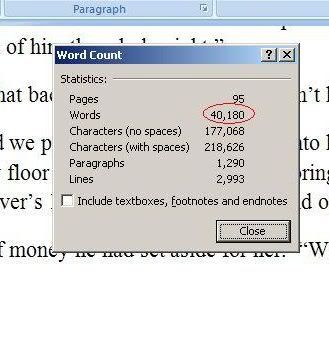
To where you ask? Like I'm supposed to know. I'm just the guy putting the words on the page. 40,180 of 'em to be somewhat precise.


After close to a year of beard wringing, alcohol induced typistry I hit the halfway point of my book. Wordcount wise I'm shooting for 80,000ish. These things are constantly evolving so who knows what the final will be. We have a plot, we have characters doing stuff, we have words on multiple pages, some of which by mere circumstance are actual sentences.

Looks like I'm running out of excuses to finish the dern thing.

If you're writing fiction or considering to do so, I want to recommend Self Editing For Fiction Writers by Renni Brown and Dave King. I picked it up because I'm slowly working into the editor's mindset for when I have to go back and reread this monster from scratch.

Ugh.

Usually after I finish something I can't bear to look at it. Don't know why. Maybe it's the closeness to the project and emotional immediacy. I find it hard to not become attached to whatever I'm working on but it never feels right when it's fresh. Not until I set it aside and look at it a couple of months later. Then I can edit without prejudice.

I'm thinking this will be wrapped up early next year if things continue as they have.

Saturday, September 5, 2009

Unique Perspective

The conversation always works out better in my head. When it comes to executing what I imagine to be a witty remark, the words decide to take a detour at the last minute and instead of saying what I want to say I end up saying something like what I wanted to say.

"The difference between the right word and the almost right word is the difference between lightning and a lightning bug." -Mark Twain

See the dilemma? With mere mortals this isn't an issue, well not that it shouldn't be but I can shrug off the disproving stare of a fellow steerage class yokel without a thought. Just as I'd imagine they're likely to forget the words no sooner than they've left my mouth and collided with their ear. I think most people aren't really listening to 80% of what I say anyway and that's fine since I don't talk to most people.

There are writers that I like, writers that I love and writers that make me wring me hands in despair, tear at my beard and wail things like: "I will never be able to write like that!!!" Luckily, most of the last group are dead so I don't have to face the stomach turning experience of meeting them in public.

I'll pause so you can fix your hyperbole detector.

It's not jealousy, I don't think so anyway. Writing fiction to me, is a way to document your world view, a method of transforming your interior dialogue into something tangible. Taking an idea and giving it your own distinct voice. To be jealous of the way someone else perceives the world is a little insane don't ya think? Even with 6 Billion people covering the planet it's plain to see that differing degrees of perception are limited.

This is why I can read novels written hundreds of years ago set in places nowhere close to mine and relate to the characters and principles within. This is why music by Bach, Beethoven, Mozart etc. stands the test of time. Why Rodin's The Thinker isn't going to ever stop being a great piece of art. This is why the story of Romeo and Juliet has been retold a million times with a million different variations and will never stop being told until Forbidden Love is driven out of humanity's conscience.

The external shininess of the human experience might change but if you rip away all the I-Phones, interwebs, cable television and the like, have our hopes and dreams really changed that much from the days of people drawing pictures on the walls of caves? Isn't happiness forever the goal, no matter the definition of happiness to the person?

Occasionally I'll read a phrase, sentence, story, whatever and be reduced to a trembling wreck because someone will express an idea that I've been turning over an over in my head more or less since I could walk.

Then the beard tearing, hand wringing and self flagellation begins until I'm so numb with pain I can't remember what it was that upset me. Recently it's this line by Scarlett Thomas from The End of Mr Y.

"'Fact' is a word. Science itself is just a collection of words. I'm guessing that truth exists beyond language, and what we call 'reality.' It must do; well, if it exists at all, that is."

I'm in a constant crusade in this belief, that there really aren't any absolute truths contained within the human experience. We haven't reached a point where we're able to quantify them and even the ones that we assert as absolute we have no way of knowing where the truth actually lies.

Why? Because we're the ones coming up with the methods of discerning this truth and people, to a large extent are incomparably flawed. Why wouldn't our methods be as well?

Don't take it personal, humanity but you are and it's no jab either, it's just something you need to learn to accept.

When it comes to ideas, personal philosophy, innovation and the like, I'm of the opinion that there's only a finite amount of the stuff out there more or less recycled and reinterpreted since antiquity.

This isn't a negative by any means. Understanding that you may have reinvented a rounder wheel shouldn't come with stigma because of the lack of uniqueness attached to the idea. The only thing that matters in the end is whether or not the idea works and has validity outside of the "creator".

I propose that people need to take a step back from themselves and instead of worrying about their own creativity and how special they are, look at the world around you and see how you relate to it and it to you.

Instead of saying someone has a stupid idea because you don't believe it, try to understand why that person came to this conclusion and rationally explain your position. It can be done.

Lastly, before you condemn an idea at least have an actual understanding of why you are condemning it. Maybe I'm wrong for thinking this but I do believe just about every idea has merit. It may not to me but if it does to someone out there than who am I to question it on that scale?

All I can do is a agree or disagree with it and move on. I don't feel I'm in a position to tell people how to think about things, just as I don't want anyone ever telling me how to think.

That doesn't mean that I won't tell people that they should think. By all means think, all the time, NEVER STOP and if we reach different conclusions let's hash it out and maybe we'll both come away from it a little more learned even if our positions stay exactly the same.
Monday, August 31, 2009

The Hunt and Peck Diaries (Continued)

We're doing a little dance now. 36,064 words only one instance of the word 'hurried'. That is certainly worth celebrating.

'Point' and 'pointed' however will need to be phased out in revisions. Guess I'm fond of characters that hand-talk.

On to other things.

A couple of Fridays ago, talking to my homie on IM about the new Quentin Tarantino movie... actually it wasn't a real conversation. It had some elements of conversation; more than one person involved, dialogue, etc. but mostly I berated him about getting to see Inglorious Basterds first.

SO THERE.

Have you seen it? Don't tell me you're one of those people that hates Tarantino because of something he said or did one time or his excessive use of violence and the N-word, THE EAR SCENE, etc.

You might want to stop reading here.

I was probably an average Tarantino fan until Kill Bill Vol 1. One of my all time favorite scenes in a moviefilm involves Beatrix Kiddo (funny that Tarantino triggers the spell check and Beatrix Kiddo doesn't lolz) dispatching 88 crazed NINJAS with a samurai sword, even plucking the eye from that one idiot stupid enough not to wear goggles that day. Not to mention all the other elements of uber stylized coolness in that film.

Also, when it comes to suspense, especially of the Hitchcock kind, he's on a whole nother level with that. I squealed and grabbed Paola's arm during the diner scene in Death Proof. The camera does a slow pan and low and behold, Stuntman Mike is sitting at the bar, enjoying a coffee apparently listening in on the ladies' conversation. The camera finally pans back around and he's gone making you wonder if he was even there in the first place. Foreshadow much?

QT happened to be on Tavis Smiley doing the standard movie promotion tour. Didn't get a chance to see the whole thing but I caught this little snippet in which he talks about the art of storytelling.

Hold that thought for a second.

In constructing my epic novel in lyrical prose, Man Loses Hat, Man Finds Hat, I've discovered that I'm the type of writer that really likes to wander in the woods. Writing fiction, some say is an exercise in problem solving. The writer asks a question that they don't know the answer to and creates the prose to discern a solution.

I create situations for my characters sometimes that completely stymie me and spend days agonizing over how to resolve them while moving the plot forward. I have a general idea of where I'm going. Now that all the major players are in action it's just a matter of moving the pieces around until I reach the desired outcome.

Easy like Sunday morning?

Having a general idea is nothing compared to taking that same idea and stretching it out over the span of 80,000ish words. Which is where the clip comes in. As I muddle along through this thing, allegiances and motivations change, certain characters become superfluous and the plot becomes more convoluted. I know when I'm finished there will be a lot of stuff stricken from the original draft and scenes will be ordered in a manner more conducive to plot development.

QT talks about coming into the theater in the middle and sticking around after the movie to watch the beginning until the rest of the movie makes sense. This is what writing the novel feel like to me.

The beginning isn't really the beginning. All the important back story that makes the characters who they are constitutes the beginning and we're not going to dwell on that. We're going to dwell on the story which is what's happening NOW and in order to do that I've realized that writing everything in a chronological order is to my detriment.

It is small epiphany but one that I think will really help me down the road. Write the scenes worry about the chronology and plausibility later. This I can handle.

By the way. I did outline this thing, heavily and it's not even close to what I'm ending up with. Think I'll send a copy of it to the brave souls who volunteer to beta read for me. Just for giggles.

Tuesday, August 25, 2009

Death by a Thousand Epiphanies (on Macguffins)

While watching the dreadful movie Push with Paola this weekend I asked her, about midway through, "Do we really need to know what's in The Case?"

She said, "For the purposes of this movie, yes."

Which in my mind is an instant fail.

The existence of The Case should be enough. If you have to stop and explain to people what is going on and why something is important then it means the supporting elements surrounding the central theme aren't doing enough on their own to convey this message.

As a viewer/reader, I only need to know The Case is important, the protagonist and/or antagonist desire it enough that they're willing to make each others lives hell in order to get it. Or some variant of such. Pick your trope.

Getting inside the case presents the problem of building up to a gigantic anti-climatic moment. Once the stakes are raised too high, opening The Case may at best please some of the audience but you ain't gonna get them all, especially me. If a tangible, physical value is attached to the items within then the questions start: "You're kidding me! I don't know if I would've done all of that for that."

The Case represents our deepest hopes and dreams, a solution to the meaningless drudgery of our everyday situation, an escape from the normal, a new beginning. The Case, in order for it to be important to everyone needs to be all things to all people. The Case is only a means to an end, not the end itself. It is how we get the ball rolling, how we nudge the protagonist forward to make sacrifices and to change. Make your story good enough and nobody will care what's inside that case.

More on Epiphanies later.

Wednesday, August 19, 2009

Breaks are for the Broken

Beginnings are easy, endings are hard, middles are tedious.

This is all you need to know about writing a novel. Those darn middles are where good ideas go to wallow and become mediocre.

WALLOW.

If you add an s to that it becomes swallow, which could either be a graceful bird or action that one does when confronted with explaining what their idea is about (or when consuming a beverage(s) that makes you forgot about said idea).

I don't feel like anything I've ever worked on is so irrevocably broken that a healthy dose of editing couldn't fix. Even my first novel attempt, that I cringed at the idea of rereading for 13 whole years isn't that bad in retrospect. I would never do anything with it but it sure is nice to look at that thick sheaf of words and say "Holy crap, I wrote this and it doesn't make me want to puke."

That doesn't do anything for finishing though. In fact, a lot of what I read about the art of writing novels suggests that it's a bad idea to go back and reread, period. In the first draft portion, the writer should be focused with burping words onto the page, not even pausing to correct obvious grammatical and spelling mistakes. The first draft is for the writer to tell the story to themselves. Then go back and write the darn thing, already.

This is all conjecture of course. Lawrence Block says no one can really tell you how to write a novel, no one except you of course and you only learn by completing one.

So where does that leave me? 33,000ish words in but I need to take a break. I have a short story idea that won't go away and it must be indulged. It's about... well go read that older post if you don't know because it's always about love. I think this should take about a week or two to hash out, probably leave it in draft form and hop back onto the horse. Besides, I don't feel so bad when hearing about first time novelists that took more than 3 years to get it done.

In the meantime, finally got around to reading Scarlett Thomas. Loving the End of Mr. Y, the whole thought experiment thing is kind of cool. Gave me all kind of ideas.

I have a thought experiment involving money. Give me some. Now.

Discuss.

Monday, August 3, 2009

Context

If you meet someone, for the first time in life, as in never spoke a word to this person before and the second sentence that comes out of their mouth is: So, what have you been up to?

Is there a proper non-sarcastic way to answer that other than a shoulder shrug?

Discuss.

Friday, June 12, 2009

The Thing About Apples or Two Ideas Collide

My blog dashboard is about as cluttered as my desk. There are 20-30, 200 word starts that have fizzled out in mid sentence. How's that for inspiration? The problem for me is that I don't want to fact check or put up something erroneous when I'm in the middle of making a grandiose assumption about human nature. This is why I prefer to write fiction cause I can just make the shit up as long as it's logical within the rules of my universe.

Those of y'all that manage to stay on top of your blogs should know that I envy you. There's some good content floating around on these interwebs, a lot of it free, a lot of it very entertaining, so I advise you, dear reader, to take a look at some of the links over thattaway ------->

...after I lull you to sleep with my diatribe. Or before. Either way. I'm easy like that.

There are few things I enjoy on this earth more than a crisp Granny Smith apple. It's a lunchtime ritual for me that always starts with peeling the origin sticker off, taking the first bite then deciding if it's worth it or not to continue. I did say crisp, see. I know a lot of tricks to determine an apples worthiness beforehand but you can never rule anything out until the actual taste test. Until your teeth break the skin it's just a guessing game.

The thing about apples is that a lot of stuff goes on under that skin, one of which is pesticides. I'm too lazy to source the article but apples are one of the worst offenders when it comes to retaining pesticides. Not that this is the apple's fault. It just the nature of their design. Unless you're fully kitted out with the latest testing gear, the average consumer doesn't stand a chance of knowing what they're putting into their body.

So what does one do? If you're concerned about turning your body into a toxic waste receptacle you can go organic, which is what I did. Organic apples don't keep as well though, go figure. When nature has its way and they're allowed to degrade as they should, it leads to a shorter shelf life. This is fine, it just means that the end user needs to be a little more selective and not ignore the little voice warning you that a ball of mulch lurks underneath that green skin.

On Monday, I sat down to lunch and peeled the origin sticker off, shocked to see that it said "New Zealand/Organic." Maybe I wouldn't have been shocked if I didn't live just on the other side of Stevens Pass from the Apple Capital of the World.

So I'm munching on my apple, feeling a bit like Paul McCartney might have the first time he laid eyes on his hybrid Lexus. Okay, not quite. I'm sure Sir Paul didn't feel even a minor twinge of guilt but I did. It got me to thinking about a speech I heard by Arundhati Roy about the EVVVVEEEELLLLSSSS of globalization. I'd recommend listening it to yourself (and her other stuff because she's a freaking genius) but I'll pharaphrase: Globalization has absolutely nothing to do with the consumer and everything to do with the profit.

Seriously, please explain to me how an apple that comes thousands of miles via container ship, offloaded at the port by union longshoreman, then delivered to a wholesaler by a truck be cheaper than one that's only a hundred miles away still on the dern tree?!

Well, I'll tell you how. The only way that apple could be cheaper would be to reduce the production costs, which means paying the workers less. Considering their competing against migrant farm workers in America, imagine how much less that means they're getting paid.

I can't stomach that, organic or no. I don't want to eat New Zealand apples when I could drive to Wenatchee and load up my car with crates of apples. I don't want apples from halfway across the world when they may as well be in my backyard already.

Is there a solution? I don't know. Maybe it's time to buck up and wander down a Farmer's Market to see what they're all about.